Vesuvius Shot 20–30 km Into the Sky. Let That Sink In.
 Christian Haslbeck·
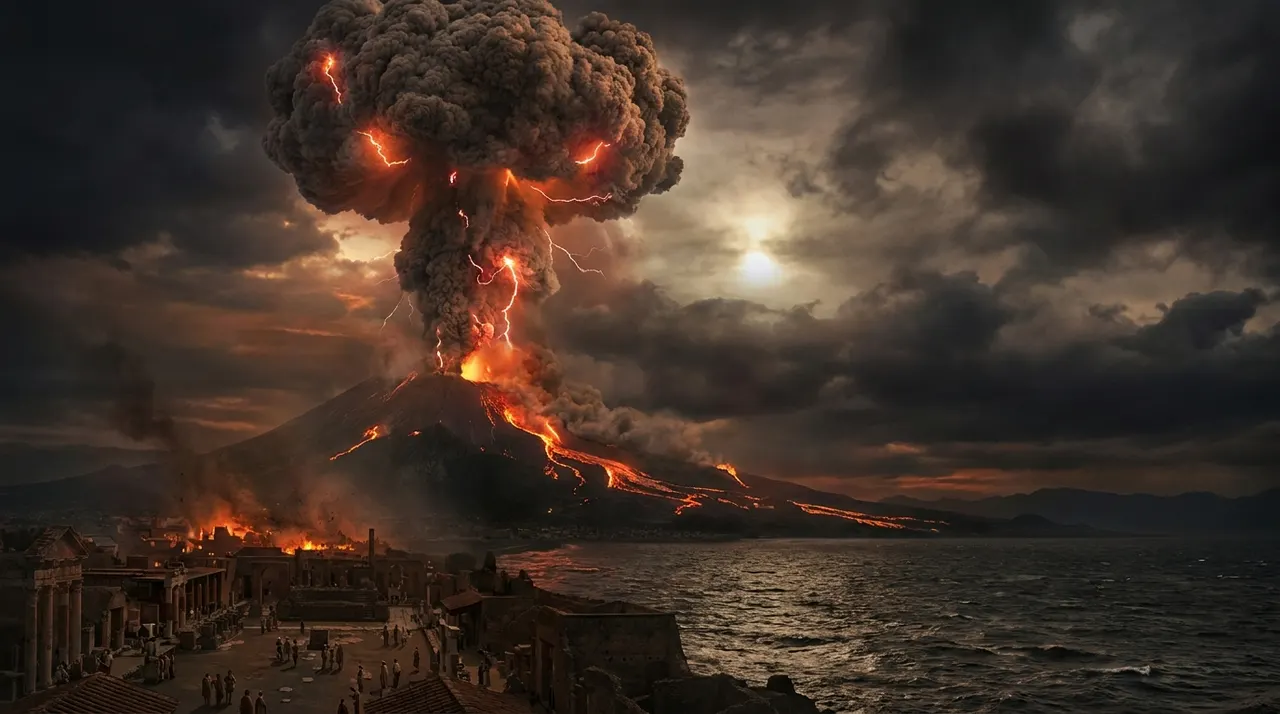
The eruption of Mount Vesuvius in 79 AD didn't just bury Pompeii — it blasted a column of ash and rock 20 to 30 kilometers into the atmosphere. Here's why that number is absolutely insane.
Let me just say this upfront: a mountain punched a column of superheated gas, rock, and ash 20 to 30 kilometers straight into the sky.
Not 200 meters. Not 2 kilometers. Twenty to thirty kilometers.
That's roughly the altitude at which weather balloons float. It's higher than commercial planes fly. It's basically the edge of the stratosphere — and Vesuvius got there in a matter of hours on August 24th, 79 AD.
The Numbers Are Genuinely Hard to Process
Modern jets cruise at about 10–12 km altitude. The eruption column of Vesuvius during its peak phase was more than twice that height. We're talking about a column of destruction so tall that if you stacked three Mount Everests on top of each other, you'd just about reach the top of it.
In terms of energy: scientists estimate the eruption released energy equivalent to 100,000 times the atomic bomb dropped on Hiroshima. Per day. For nearly 24 hours straight.
The column was so massive it blotted out the sun across a huge swath of southern Italy. Survivors described mid-afternoon turning into complete darkness. The Roman writer Pliny the Younger, who watched from a safe distance across the Bay of Naples, wrote that it looked like an enormous pine tree growing out of the mountain — the trunk shooting upward and then spreading out at the top into a canopy of death.
What Was Actually Flying Up There
It wasn't just ash. The column contained:
- Pumice stones the size of fists raining down on Pompeii at over 150 km/h
- Pyroclastic material at temperatures exceeding 300°C
- Sulfur dioxide and toxic gases in concentrations lethal to breathe
- An estimated 3 cubic kilometers of rock and debris ejected into the atmosphere
When parts of that column became too heavy to stay aloft, they collapsed. That's when the pyroclastic surges hit — superheated avalanches of gas and ash moving at 300+ km/h that incinerated everything in their path. Herculaneum was wiped out almost instantly.
Pompeii Didn't Stand a Chance
Most people think Pompeii was buried slowly. It wasn't. Within the first few hours, the city was under a meter of pumice. Within 24 hours, people were entombed under 4 to 6 meters of volcanic material. The weight of it caused roofs to collapse. Those who hadn't fled in the first hours were simply… finished.
The casts we see in museums today — the hollow spaces in the ash where human bodies once were — are a direct consequence of that speed. The ash hardened around them so fast that it preserved their exact positions at the moment of death. Frozen in time. Literally.
And Nobody Really Knew It Was a Volcano
Here's the kicker: the Romans living near Vesuvius didn't quite grasp what they were sitting next to. The mountain had been dormant for about 1,700 years. It was just a mountain. A fertile, scenic mountain with great vineyards. People lived on its slopes, farmed its soil, and built one of the ancient world's most vibrant cities at its foot.
The word volcano didn't even exist yet. It was coined much later, from Vulcano — another Italian island — after people started connecting the dots.
Why This Still Messes With Me
We have cities today sitting within the same range of Vesuvius. Naples. Its suburbs. Millions of people. And Vesuvius is still considered an active volcano. Scientists don't say if it erupts again — they say when.
The 79 AD eruption wasn't even Vesuvius at its historical worst. Earlier eruptions were larger. The mountain is capable of more.
So yeah. A mountain casually launched a column of rock and fire to the edge of the stratosphere, erased entire cities, and carved a hole in the Roman world that we're still excavating and studying 2,000 years later.
Absolutely unhinged. 10/10. Nature doesn't care.